Decoding Vitruvian Man: Da Vinci's Quest for Perfect Human Anatomy
Leonardo da Vinci, often hailed as the quintessential "Renaissance man," embodied a rare fusion of artistic brilliance and scientific rigor. While his iconic masterpieces like the
Mona Lisa and
The Last Supper secure his place in art history, it is his vast collection of scientific sketches that truly illuminate the depth of his encyclopedic knowledge and eclectic interests. Among these, one drawing stands out as a powerful symbol of his genius and humanity's enduring fascination with perfection: the
Vitruvian Man.
Dating from the late 15th century, the
Vitruvian Man is far more than just a drawing; it is a profound exploration of proportion, a work that seamlessly blends art with mathematical and anatomical precision. For Leonardo, "everything connects to everything else," and this piece serves as a visual manifesto for that belief, illustrating the inherent harmony between the human form and the universe itself.
The Vitruvian Man: A Masterpiece of Interconnection
Created around 1487-1492, the
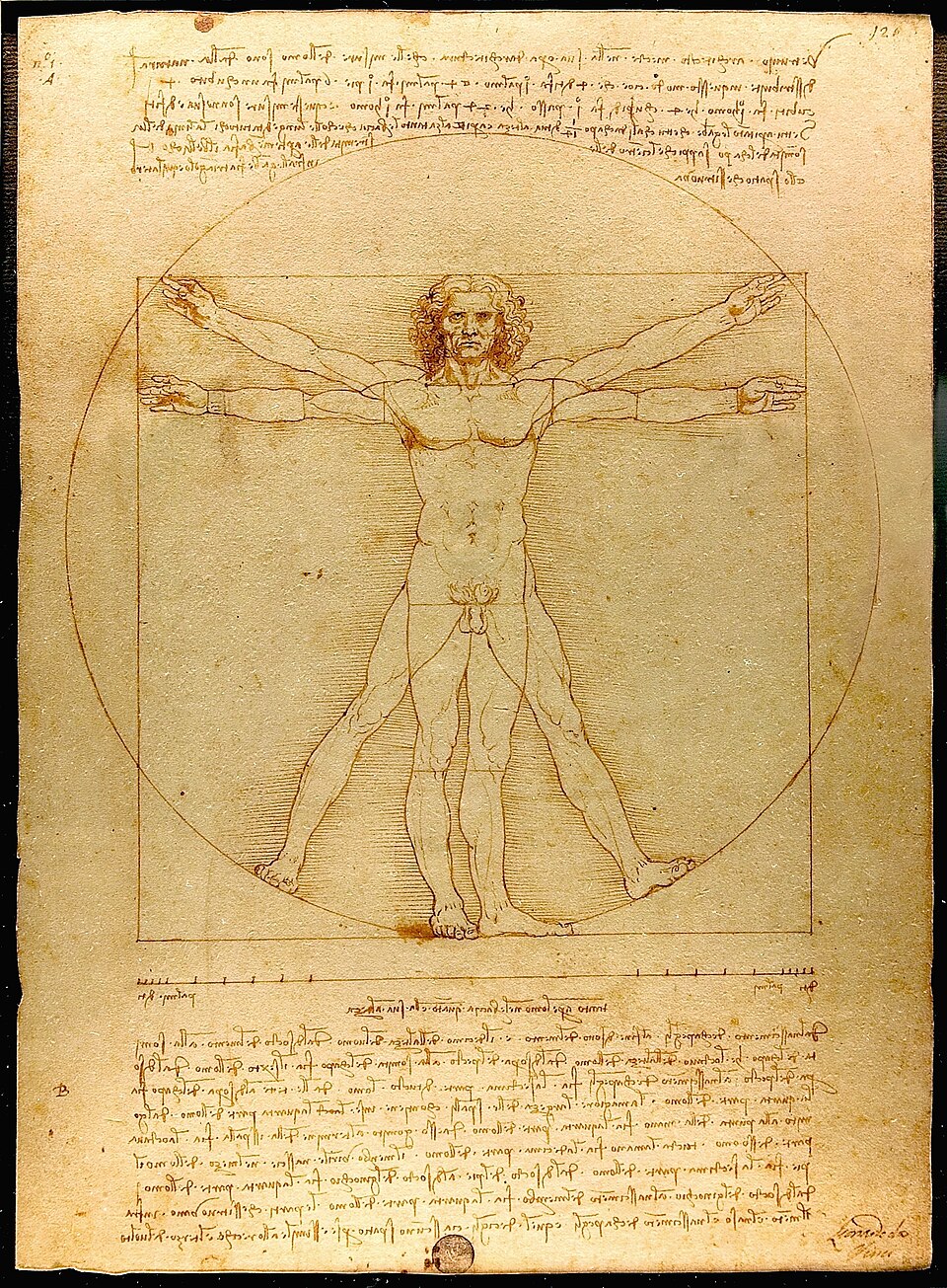
Vitruvian Man, also known by titles such as “The Proportions of the Human Body According to Vitruvius” or the "Canon of Proportions," is rendered in meticulous pen, ink, and metalpoint on paper. The drawing presents an idealized male figure, nude, superimposed in two positions: one with arms and legs outstretched to fit within a square, and another with limbs spread wider, fitting perfectly within a circle. Leonardo's ingenious choice to depict the man with four legs and four arms allows him to capture 16 simultaneous poses, illustrating the geometric principles at play with striking clarity.
This remarkable drawing is a testament to Leonardo's belief in the interconnectedness of all things – a core tenet of Renaissance humanism. It represents the human being as a microcosm, mirroring the grand design of the cosmos. The precise geometry isn't just an artistic flourish; it's a scientific inquiry into the underlying order of nature. This profound piece is currently safeguarded in the Gallerie dell'Accademia in Venice, Italy, and due to its delicate nature as a work on paper, it is displayed only occasionally, making each viewing a rare privilege.
Ancient Wisdom Meets Renaissance Genius: The Vitruvian Influence
The intellectual foundation for Leonardo's
Vitruvian Man lies in the ancient world, specifically the writings of the Roman architect and engineer Vitruvius Pollio. Between 30 and 15 BC, Vitruvius authored
De Architectura, a comprehensive treatise on architecture that, surprisingly, also delved into the geometry of "perfect" human proportions. Vitruvius proposed that a well-designed building, like the human body, should possess symmetry, balance, and aesthetic harmony, all based on mathematical ratios.
For Vitruvius, the human body was the ultimate model of perfection, with its parts arranged in natural, harmonious proportions. He noted that the navel was the natural center of the body, and if a man lay on his back with arms and legs extended, his navel would be the center of a circle circumscribing him. Furthermore, his height and the span of his outstretched arms would be equal, allowing him to fit perfectly within a square. This concept deeply resonated with Leonardo, whose own interests spanned anatomy, art, and engineering. It provided the ideal framework for his quest to understand the underlying mechanics and aesthetics of the human form. The confluence of classical ideals with Renaissance scientific curiosity truly brings to life the message of
Vitruvian Man Explained: Leonardo's Scientific Illustration of Body Proportions.
Leonardo's Anatomical Journey: Unveiling the Human Machine
Leonardo da Vinci's fascination with human anatomy began early in his career, even during his apprenticeship. Unlike many artists of his time who might have only superficially studied the human form for artistic representation, Leonardo embarked on a relentless, methodical quest for deep anatomical understanding. He is recognized as one of the most important anatomists of his era, pioneering scientific observation and illustration.
His meticulous studies involved the audacious and often taboo practice of dissecting over 30 human corpses. In an age where such practices were fraught with societal and religious disapproval, Leonardo's dedication was extraordinary. His initial drawings focused on the skeletal and muscular systems, detailing every bone, tendon, and muscle with incredible accuracy. However, his interest quickly evolved beyond mere appearance to understanding the *mechanics* and *function* of the human body. He wanted to know not just what things looked like, but how they moved, how they worked, and what principles governed their operation.
Leonardo's countless anatomical notes and illustrations are an incredible testament to his scientific mind. He recorded everything with astonishing precision, often employing cross-sections, exploded views, and multiple perspectives to convey complex structures. While he largely kept these detailed anatomical drawings private during his lifetime, they have since been published widely, revolutionizing the fields of art and science. Many consider them the earliest examples of true scientific illustration, setting a precedent for accuracy and clarity that would influence generations.
Decoding the Proportions: Leonardo's Text Unveiled
Accompanying the iconic drawing are two blocks of text, written in Leonardo's characteristic backward script (mirror writing), which further explicate his findings and Vitruvius’s original principles. This text isn't just an annotation; it's an integral part of the drawing, clarifying the mathematical ratios that define the "ideal" body.
In the first section, Leonardo meticulously outlines the precise measurements:
- Four fingers make one palm.
- Four palms make one foot.
- Six palms make one cubit.
- Four cubits make a man's height.
- Four cubits make one pace.
- Twenty-four palms make one man.
He then elaborates on the geometry of the square and circle: "If you open your legs so much as to decrease your height 1/14 and spread and raise your arms till your middle fingers touch the level of the top of your head you must know that the center of the outspread limbs will be the navel and the space between the legs will be an equilateral triangle." This precisely details how the human form, when positioned correctly, can perfectly inscribe itself within both a square and a circle, with the navel serving as the fixed center of the circle. The square's sides are defined by the man's total height and arm span, which Leonardo, following Vitruvius, states are equal.
This detailed explanation isn't just about anatomical measurements; it's a philosophical statement. It suggests a divine order in human design, where the body’s proportions reflect universal principles of harmony and balance. It bridges the physical world with the metaphysical, seeing the human form as a microcosm of the universe’s perfect geometry.
The Enduring Legacy of Ideal Proportions
The
Vitruvian Man transcends its status as a mere drawing; it has become a global icon, instantly recognizable and loaded with symbolic meaning. Its enduring power lies in its ability to encapsulate the Renaissance ideals of humanism, rationalism, and the pursuit of knowledge. It celebrates the human form not just for its aesthetic beauty, but for its mathematical and scientific perfection.
In modern times, the
Vitruvian Man continues to inspire and inform across various disciplines. Artists still study its proportions for figure drawing and sculpture, understanding that Leonardo’s meticulous approach provides timeless guidelines for balance and realism. Architects and designers draw lessons from its principles of symmetry and ratio, recognizing the enduring appeal of forms rooted in natural harmony. Even in fields like ergonomics and biomechanics, understanding ideal body proportions and movements has practical applications, from designing comfortable workspaces to optimizing athletic performance.
Furthermore, the
Vitruvian Man has permeated popular culture, appearing in countless books, films, and advertisements as a symbol of human potential, scientific inquiry, and the harmonious blend of art and science. It serves as a constant reminder of Leonardo da Vinci's unparalleled genius and his vision of a world where every element, from the smallest human finger to the grandest architectural design, is governed by universal principles of proportion and connectivity.
Practical Insight: Applying Vitruvian Principles Today
Understanding the proportions laid out in the
Vitruvian Man isn't just a historical curiosity. For artists, it offers a foundational understanding of anatomical symmetry crucial for realistic rendering. For designers, it inspires the creation of spaces and objects that feel inherently balanced and pleasing to the human eye, echoing the classical principles of good design. Even for individuals interested in health and fitness, appreciating the body's natural proportions can foster a deeper connection to their physical form, influencing aspects like posture and movement efficiency. Leonardo's relentless pursuit of understanding the human machine offers a timeless lesson in comprehensive inquiry.
Conclusion
Leonardo da Vinci’s
Vitruvian Man remains one of the most compelling and instantly recognizable images in Western culture. It is a brilliant synthesis of art, science, and philosophy, born from the polymath’s insatiable curiosity and meticulous observation. Through this single drawing, Leonardo not only translated the ancient wisdom of Vitruvius into a vibrant visual form but also elevated human anatomy into a quest for universal harmony. As a potent symbol of human potential and the profound connection between humanity and the cosmos, the
Vitruvian Man continues to challenge us to see the extraordinary in the ordinary, and to recognize the intricate dance between art and science that defines our world.