Leonardo's Vitruvian Man: Where Art Meets Science & Ideal Proportions
Leonardo da Vinci, a name synonymous with genius, is often hailed as the quintessential "Renaissance man." While his iconic paintings,
The Last Supper and the enigmatic
Mona Lisa, are perhaps his most globally recognized masterpieces, it is his vast collection of scientific sketches that truly illuminate the depth of his encyclopedic knowledge and eclectic interests. Among these, the
Vitruvian Man stands as a powerful testament to Leonardo's profound belief that "everything connects to everything else," flawlessly merging the realms of art, mathematics, and anatomical study.
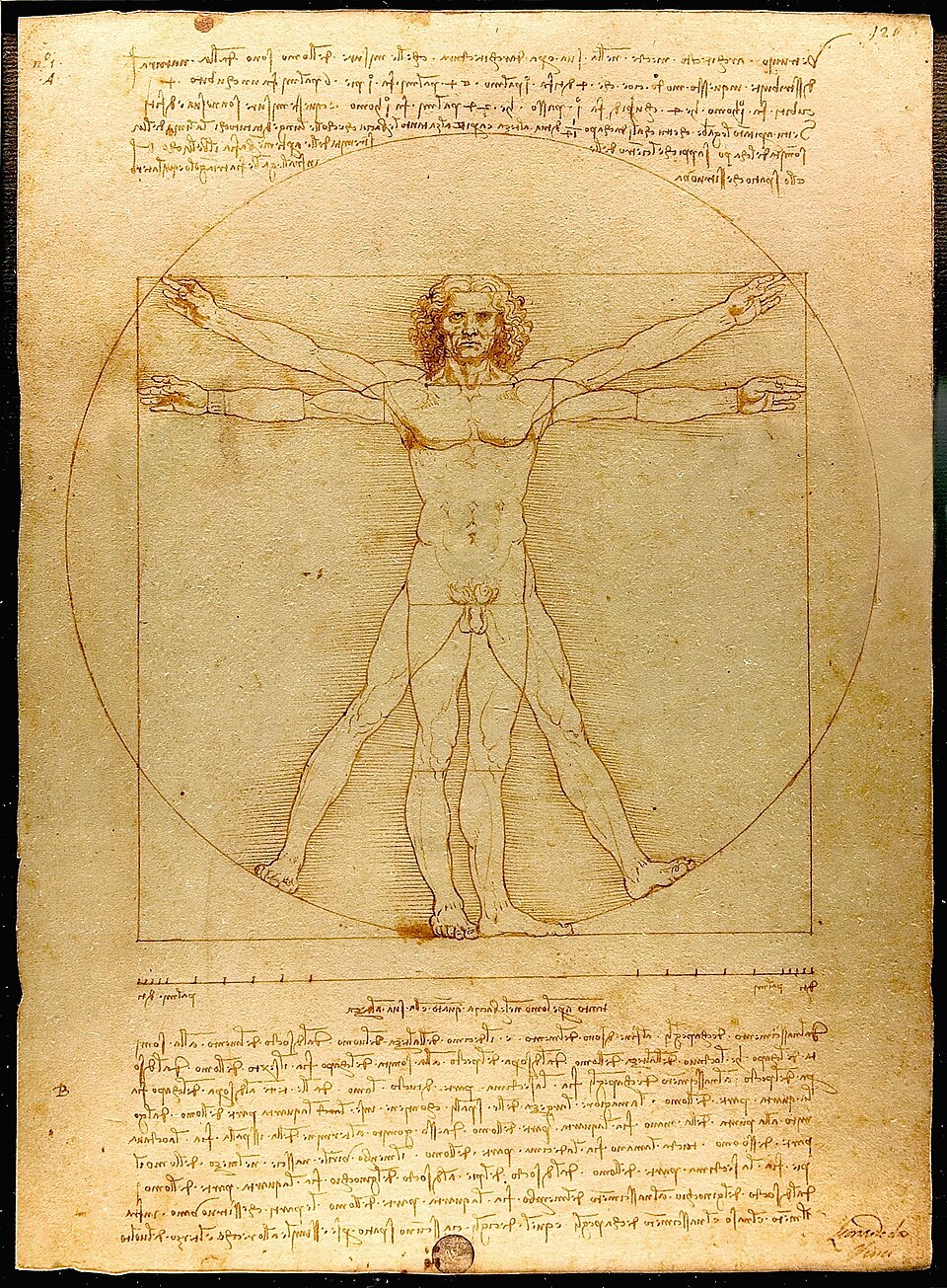
This late 15th-century drawing isn't merely a piece of art; it's a profound mathematical diagram, an exploration of ideal human proportion, and a window into Leonardo's insatiable quest for understanding the universe through the human form. Created around 1492, the
Vitruvian Man, also known as “The proportions of the human body according to Vitruvius” or “Canon of Proportions,” depicts a nude male figure in two superimposed positions. With remarkable ingenuity, Leonardo rendered the man with four legs and four arms, allowing him to simultaneously strike 16 distinct poses, perfectly inscribed within a square and a circle – symbols pregnant with meaning.
The Genesis of an Icon: Vitruvius' Influence and Leonardo's Vision
The inspiration behind the
Vitruvian Man can be traced back over a millennium to *De Architectura* (On Architecture), a monumental treatise penned by the Roman architect and engineer Vitruvius Pollio between 30 and 15 BC. While primarily a guide to building design and construction, Vitruvius’s work also delved into the geometry of the "perfect" human body, proposing that the human form could be the basis for architectural proportions. This intersection of human geometry and structural design captivated Leonardo's keen intellect and his burgeoning interest in anatomy.
Leonardo's fascination with the human body wasn't an isolated pursuit; it was deeply rooted in the intellectual currents of the Italian Renaissance. Theorists like Leon Battista Alberti strongly advocated for artists to be intimately familiar with human anatomy. Leonardo’s own journey into anatomical study began early in his career, during his apprenticeship, solidifying his place as one of the most important anatomists of his era. He meticulously studied human form, not just for artistic representation, but to uncover the underlying mathematical and mechanical principles that governed its existence. This profound curiosity about how the body was constructed and functioned laid the groundwork for his legendary drawing. To dive deeper into how ancient texts shaped this iconic work, explore
Decoding Vitruvian Man: Da Vinci's Quest for Perfect Human Anatomy.
More Than a Drawing: Unpacking Leonardo's Anatomical Obsession
The
Vitruvian Man is but one manifestation of Leonardo’s lifelong, intense study of human anatomy. To truly understand the mechanics and aesthetics of the human form, Leonardo embarked on an ambitious and often perilous undertaking: dissecting over 30 human corpses. In an era where such practices were fraught with societal and religious disapproval, his commitment was extraordinary. His meticulous notes and thousands of detailed drawings, often considered the earliest examples of scientific illustration, stand as an incredible testament to his scientific rigor and artistic precision.
Initially, his anatomical explorations focused on the visible structures – the intricate network of the skeleton and the complex musculature. However, Leonardo's mind always pushed further. He wasn't content merely with how things *looked*; he wanted to comprehend how they *functioned*. He delved into biomechanics, envisioning the human body as a complex machine, a perfect system of levers, pulleys, and forces. His relentless quest for knowledge, coupled with his fascination for the body's symmetry and harmonious proportions, was the driving force behind this exhaustive study. Though Leonardo kept his groundbreaking anatomical drawings largely private during his lifetime, fearing misunderstanding or persecution, their eventual publication profoundly impacted subsequent scientific and artistic understanding of the human body. For a comprehensive breakdown of his scientific approach, see
Vitruvian Man Explained: Leonardo's Scientific Illustration of Body Proportions.
Decoding the Proportions: The Man in the Square and Circle
At the heart of the
Vitruvian Man are the proportional relationships that Leonardo derived from Vitruvius's text. Two blocks of backward-written text, a signature of Leonardo's left-handed genius, accompany the drawing. In the first section, Leonardo translates Vitruvius's ideal body measurements:
- Four fingers equal one palm.
- Four palms equal one foot.
- Six palms make one cubit.
- Four cubits equal a man's height (and also one pace).
- 24 palms equal one man's height.
These ancient units provided a precise framework for the "perfect" human form. However, the most iconic element lies in the second part of the notes, describing the critical pose: "If you open your legs so much as to decrease your height 1/14 and spread and raise your arms till your middle fingers touch the level of the top of your head you must know that the center of the outspr..." (the note ends abruptly, though the implied meaning is clear from the drawing). This specific posture allows the figure to perfectly fit within both a square and a circle.
The symbolism here is profound. The square, with its four equal sides, traditionally represents the earthly, the material, and the quantifiable – the physical span of the human body. The circle, conversely, symbolizes the divine, the cosmic, the eternal, and the perfect unity of the universe. By inscribing the human body within both, Leonardo visually articulated the Renaissance belief in man as the "measure of all things" – a microcosm reflecting the macrocosm. This dual geometric representation suggests a "universal design" where the "medical equilibrium" of the human form mirrors the stable, harmonious structure of a well-designed building or even the cosmos itself. It posits that the proportions found in God's creation (the human body) are intrinsically linked to humanity's own perfect creations (architecture and art).
The Enduring Legacy of the Vitruvian Man
More than five centuries after its creation, the
Vitruvian Man remains one of the most recognizable and reproduced images in history. Its influence extends far beyond art history, permeating fields from science and philosophy to popular culture and design. It has become a global emblem for humanism, symbolizing the intersection of art and science, ideal beauty, and the boundless potential of human inquiry.
This iconic drawing stands as a powerful reminder of the Renaissance ideal: that true understanding comes from integrating diverse fields of knowledge. Today, the principles of proportion and balance explored in the
Vitruvian Man continue to inform disciplines like ergonomics, product design, and even medical illustration. Its enduring presence underscores the timeless human fascination with our own form, our place in the universe, and the elegant mathematical order that underpins both. The original drawing, a delicate work in pen and ink on paper, is meticulously preserved in the Gallerie dell'Accademia in Venice, Italy, and due to its fragility, is displayed only on rare, special occasions, further enhancing its mystique and value.
Conclusion
The
Vitruvian Man is far more than a mere sketch; it is a profound philosophical statement rendered in ink. It embodies Leonardo da Vinci's extraordinary genius and his relentless pursuit of knowledge, seamlessly blending artistic perfection with scientific investigation. Through this single, powerful image, Leonardo bridged the gap between the measurable and the aesthetic, the earthly and the divine, proving that in the human form, art and science truly meet to reveal ideal proportions and a universal design. It stands as a timeless symbol of humanity's enduring quest to understand itself and its place within the intricate tapestry of the cosmos.