Vitruvian Man Explained: Leonardo's Scientific Illustration of Body Proportions
Leonardo da Vinci, often celebrated as the quintessential “Renaissance man,” personified the era's boundless curiosity and ambition. His genius transcended the traditional boundaries of art and science, making him a master painter, sculptor, architect, musician, scientist, inventor, anatomist, and more. While masterpieces like the *Mona Lisa* and *The Last Supper* solidified his fame in the art world, it is arguably his scientific sketches that most vividly illuminate the depth of his encyclopedic knowledge and the sheer breadth of his interests. Among these remarkable works, none captures the essence of his holistic approach quite like the **Vitruvian Man**.
This iconic late 15th-century drawing isn't merely a piece of art; it's a profound mathematical diagram, a scientific illustration, and a philosophical statement woven into one. The
Vitruvian Man serves as a compelling visual argument for Leonardo's enduring belief that "everything connects to everything else," demonstrating the harmonious relationship between human anatomy, geometry, and the cosmos. It stands as a timeless testament to humanity's quest to understand itself and its place in the grand design of the universe.
The Genesis of an Icon: Where Ancient Wisdom Met Renaissance Genius
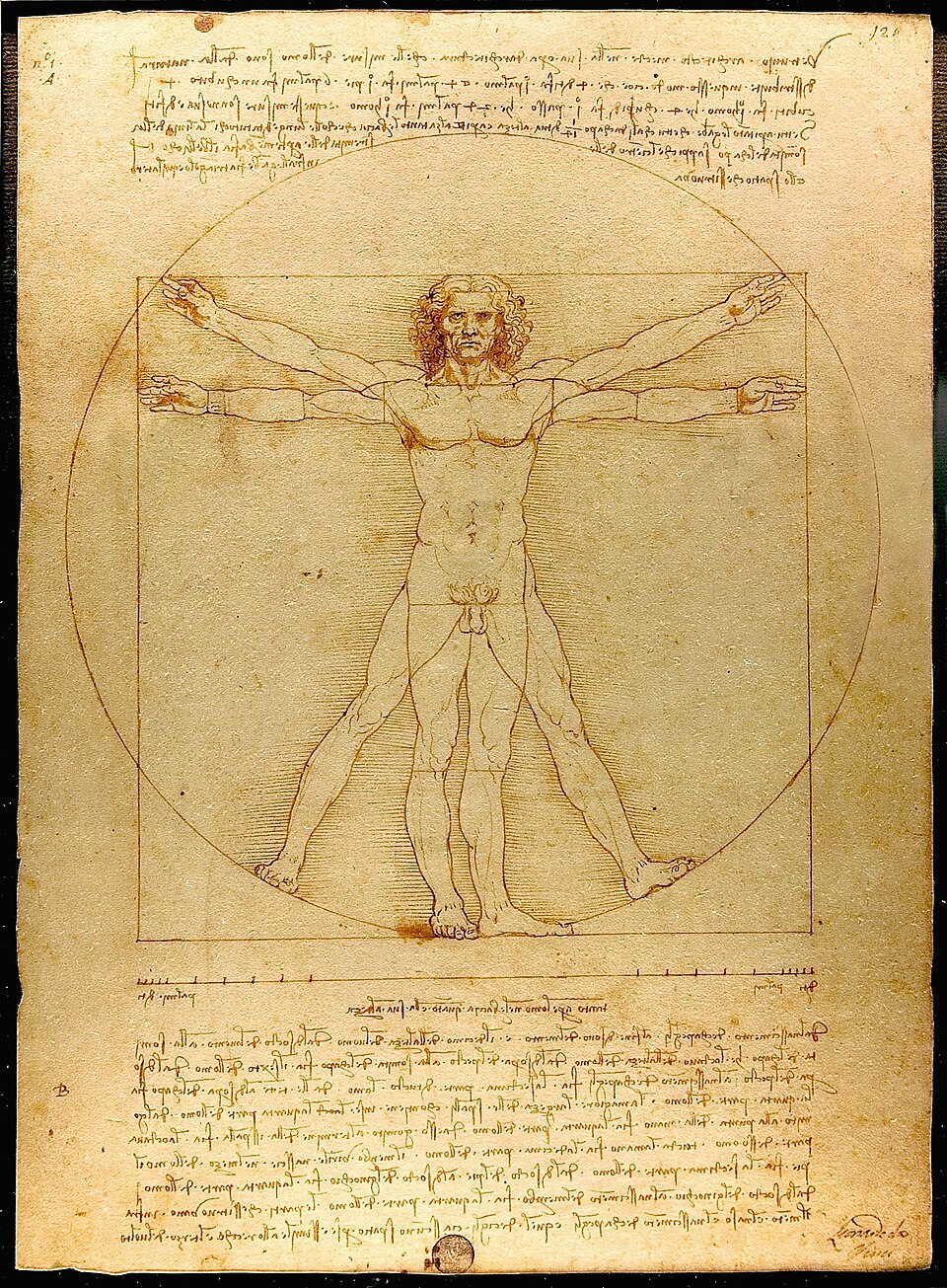
Created around 1492, the Vitruvian Man, also known as "The proportions of the human body according to Vitruvius," emerged from Leonardo's insatiable drive for knowledge. Rendered with meticulous detail in pen, ink, and metalpoint on paper, the drawing depicts an idealized male figure, nude, simultaneously inscribed within a square and a circle. This ingenious composition allows the man to strike two distinct poses, with four arms and four legs, effectively demonstrating 16 potential positions that articulate the classical understanding of perfect human proportion.
The foundational inspiration for Leonardo's work came from an unexpected source: *De Architectura* (On Architecture), a comprehensive building guide penned by the Roman architect and engineer Vitruvius Pollio between 30 and 15 BC. While primarily focused on architectural principles, Vitruvius's treatise also delved into the geometry of the "perfect" human body, proposing that the human form itself was a model of divine proportion and could serve as the basis for architectural design. This ancient concept deeply resonated with Leonardo's burgeoning interest in anatomy and his broader quest to understand the mechanics of life.
Leonardo's fascination with the human body began early in his career, driven by the burgeoning Renaissance ideal that artists should be deeply conversant with human anatomy, as advocated by theorists like Leon Battista Alberti. This pursuit led him to undertake extensive and groundbreaking anatomical studies. It is documented that Leonardo dissected over 30 human corpses, an incredibly rare and often clandestine undertaking for his time. His meticulous notes and detailed drawings, which many consider the earliest examples of scientific illustration, were revolutionary. Initially focusing on the skeleton and musculature, his studies evolved to consider the dynamic mechanics of the body, examining not just how structures looked, but how they functioned in motion and at rest. This comprehensive approach, explored further in
Decoding Vitruvian Man: Da Vinci's Quest for Perfect Human Anatomy, solidified his legacy as one of history's most important anatomists.
Unpacking the Proportions: Geometry, Symmetry, and the Human Form
The very construction of the Vitruvian Man is a masterclass in visual communication. The male figure, with his navel as the central point, perfectly fits into a circle when his arms and legs are spread. Simultaneously, with his feet together and arms outstretched horizontally, the figure aligns precisely with the boundaries of a square. This dual geometric harmony is the crux of the drawing's message. The square, with its rigid corners and equal sides, traditionally symbolizes the earthly, the mundane, and the measurable aspects of human existence. The circle, with its infinite curve and lack of beginning or end, represents the divine, the cosmic, and the spiritual perfection. Leonardo's genius lies in illustrating how the human body, the pinnacle of God's creation, can seamlessly inhabit both the earthly and the divine realms.
Accompanying the drawing are two blocks of text, written by Leonardo himself in his characteristic mirror script – a practice thought to keep his personal notes private. These notes directly reference Vitruvius's ideas, detailing the specific measurements of the ideal human body:
- Four fingers make one palm.
- Four palms make one foot.
- Six palms make one cubit.
- Four cubits make a man's height.
- Four cubits make one pace.
- 24 palms make one man.
Beyond these fundamental ratios, Leonardo also transcribed Vitruvius’s more dynamic instructions: "If you open your legs so much as to decrease your height 1/14 and spread and raise your arms till your middle fingers touch the level of the top of your head you must know that the center of the outspr..." This instruction directly informs the circular pose, establishing the navel as the geometric center of the figure within the circle. For the square pose, the figure's height is equal to the span of his outstretched arms, with the feet together, implying a more grounded and stable stance.
Leonardo's interpretation wasn't a mere transcription; it was an active scientific inquiry. He sought to verify Vitruvius's claims through empirical observation and meticulous measurement, demonstrating the synthesis of ancient theory with Renaissance scientific method. The resulting illustration is a testament to the belief that the human body is designed with inherent mathematical order and symmetry, reflecting a universal blueprint present throughout nature and the cosmos.
Beyond Anatomy: The Philosophical and Artistic Legacy of the Vitruvian Man
The enduring appeal of the Vitruvian Man extends far beyond its anatomical accuracy or geometric precision. It has become a powerful symbol, transcending its original purpose to represent the ideals of the Renaissance, humanism, and the boundless potential of human inquiry. For Leonardo, the human form was not just a subject for artistic rendering but a microcosm of the universe, a key to understanding divine order and the laws governing nature. His drawing embodies the Renaissance conviction that man is the measure of all things, capable of comprehending and harmonizing the physical and metaphysical worlds.
The blend of art and science encapsulated in this single drawing continues to inspire and inform. For artists, it underscores the importance of a deep understanding of anatomy and proportion as foundational elements of figurative work. For scientists, it exemplifies the power of visual communication in explaining complex theories and observations. And for philosophers, it provokes thought about the human condition, our quest for perfection, and our place in the grand scheme of existence.
Today, the **Vitruvian Man** is housed in the Gallerie dell'Accademia in Venice, Italy. Due to its delicate nature as a work on paper, it is displayed only occasionally, making it a rare and precious sight for those who have the privilege to view it in person. Its fragility only adds to its mystique, reminding us of the invaluable insights it offers into the mind of one of history's greatest polymaths.
Conclusion
The **Vitruvian Man** remains one of the most recognizable and profound images in Western culture. It is not just Leonardo da Vinci's scientific illustration of body proportions; it is a monumental fusion of art, science, philosophy, and ancient wisdom. Through this single, elegant drawing, Leonardo masterfully articulated the idea that the human body is a perfect model of proportion, symmetry, and harmony, capable of fitting within the fundamental geometric shapes that define our understanding of the universe. It stands as a powerful reminder of Leonardo's genius, his unyielding curiosity, and his revolutionary approach to understanding the world around him. More than five centuries after its creation, the Vitruvian Man continues to inspire awe and spark intellectual curiosity, proving that the pursuit of knowledge, when harmoniously blended across disciplines, can yield insights that are truly timeless.